
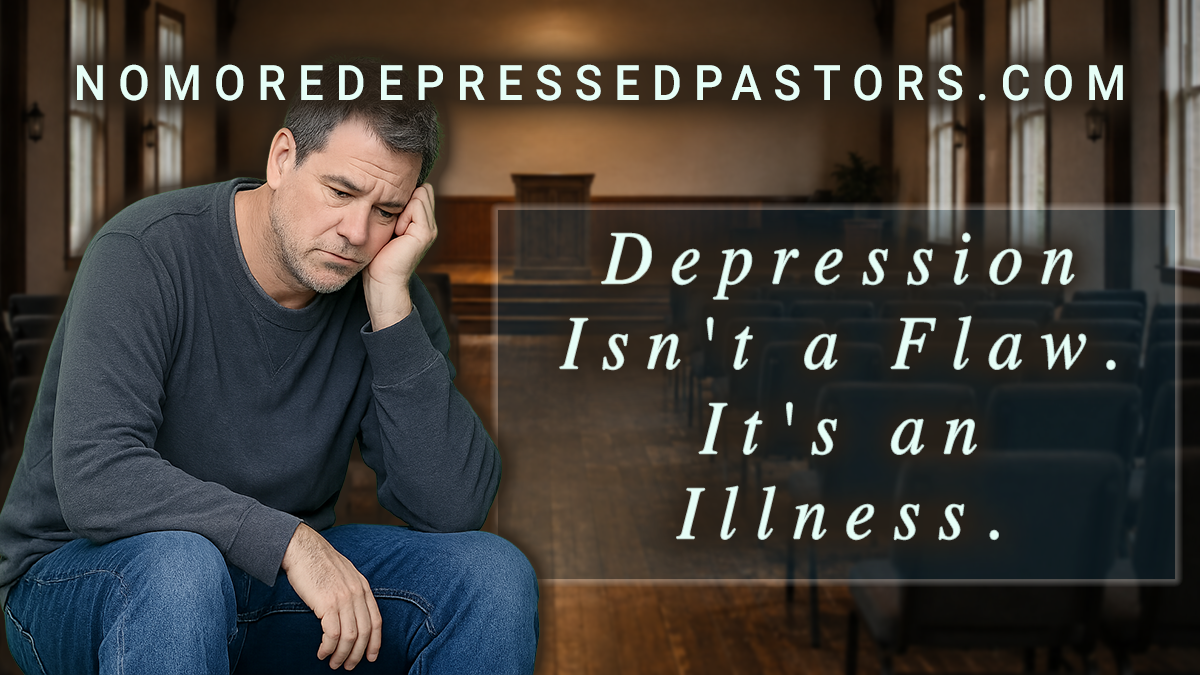
To the pastor struggling with depression,
I thank God for you. You are working to build the Kingdom of God every day. You are suffering for the gospel. You are hurting in ways that are often too much to bear. And you’re still in the fight. This is for you.
“My flesh and my heart may fail, but God is the strength of my heart and my portion forever.” Psalm 73:26 (NIV)
The Word We Don’t Apply Accurately Enough
The Hebrew word for “flesh” in this verse is basar. It means the whole physical body, with nothing carved out and nothing excluded.
The brain is flesh. It is an organ, the most complex one in your body, and like every other organ, it can get sick. Chemical imbalance is not a character flaw. It is a biological event happening inside a physical structure that God himself called flesh.
Here is what that means for you right now. When a pastor’s brain gets sick, emotions destabilize. Thinking distorts. Patience thins. Relationships suffer. You may say things you regret, withdraw when people need you, or lose your grip on things that used to come naturally. Sickness does not erase moral accountability, but it does change the conversation. It does not excuse sinful behavior, but it does explain it. Sick people do not need condemnation. They need compassion, help, and a path toward healing. That is true for a pastor with a failing liver. It is equally true for a pastor with a failing brain.
Psalm 73:26 was written for the moment you are in right now. The church just forgot to tell you that.
The Psalmist Was Where You Are
Don’t just read verse 26 without reading the whole psalm.
The writer didn’t start there. He starts by confessing he nearly lost everything, his faith, his footing, his ability to make sense of God. He says his feet “almost slipped.” In verses 21 and 22 he describes himself as grieved, embittered, senseless, a brute beast. That is not the language of a minor complaint. That is a man in genuine psychological collapse, writing honestly about what it felt like to be him. Ever felt that way yourself?
Here’s the thing: God did not rebuke the psalmist for it.
Psalm 73 ends with this: “I am always with you. You hold me by my right hand.”
Not after the collapse. Not once the psalmist had it together. God was holding his hand all the way through it. That part matters. It means that just as God did not rebuke the psalmist for his depression, He does not rebuke you for yours.
He does not excuse sin you might be committing in your depression. The Lord rebukes sin. But the Lord does not rebuke being sick.
God’s First Response to a Burned-Out Prophet
Read 1 Kings 19. Elijah is under a juniper tree, completely done. Physically depleted. Asking God to let him die.
God’s first response is not a sermon. Not a rebuke. Not a lecture on resilience or calling or the importance of finishing well.
God sends an angel with food and water and tells him to sleep.
The body gets addressed first. Then, only after Elijah has rested and eaten, does God speak to the situation. If that is how God pastors a burned-out prophet, you are in a category God recognizes completely. And you are in better hands than you feel right now.
A Perspective Worth Considering on the Incarnation
Psalm 22 opens with words familiar to every pastor: “My God, my God, why have you forsaken me?”
Jesus quoted that psalm from the cross. And I want to offer something here, not as a definitive theological statement, but as a perspective worth considering about what the incarnation actually means for you in this moment.
The incarnation is the reality of God becoming human in the person of Jesus. And as such, Jesus had the full human experience. Scripture is clear on this.
“For we do not have a high priest who is unable to empathize with our weaknesses, but we have one who has been tempted in every way, just as we are, yet he did not sin.” Hebrews 4:15 (NIV)
So that compels me to wonder: did Jesus ever have a bad day? Did he ever catch a cold or a stomach bug? We know he experienced hunger and thirst. We know he got tired and slept. I am inclined to believe that on some level Jesus experienced everything we experience.
Consider Gethsemane to Golgotha.
In the garden, Jesus sweat blood. That is a documented physiological response to extreme psychological trauma. After his arrest, he was beaten, tortured, dehydrated, and hung on a cross in the sun for hours. His body underwent catastrophic physical trauma from the garden to the grave. Consider what that did to his human brain. Consider what that level of physical damage, blood loss, and neurological strain did to his human cognitive and emotional experience.
Was Jesus quoting Psalm 22 to declare that God was no longer omnipresent? Was he forgetting his own unity with the Father? I think the cry of dereliction was Christ’s entirely human response from a mind and body under a kind of strain no person could survive. What if the incarnation means Jesus knows, from the inside, what it is to be a brain in crisis?
I am not asking you to resolve that theologically. I am asking you to consider whether the God you serve has been closer to your experience than you realize.
Two things can be true at the same time. You can be held by God and not feel held. You can be loved and feel invisible. You can know every word of the theology and still weep when you are alone.
Jesus went there, and that matters immensely.
The Stigma Has a Source, and It Is Not Scripture
The idea that mental illness is spiritually different from physical illness, more suspect, more shameful, more the pastor’s fault, did not come from the Bible. It came from Greek philosophy that seeped in over centuries. The Greeks divided the soul from the body and decided the soul was what really mattered.
The Hebrew Bible never taught that.
The ancient Hebrew concept of nephesh, usually translated “soul,” means the whole living person. The breathing, feeling, embodied human being. You are not a soul trapped in a body. You are a living body animated by the breath of God. The brain is part of that. Its illness is part of that. And God’s care covers all of it.
The stigma you are afraid of has a source. That source is not the Word of God. It is a distortion of God’s actual creation. And that matters because Satan’s favorite tactic is to take what God created and distort the human understanding of it. It sounds convincing. And Western culture swallowed it whole.
What Psalm 73:26 Is Actually Saying to You
Your flesh is failing. Specifically, biochemically, in the organ that runs everything else. That is what is happening. And the psalmist looked at exactly that kind of failure and said: God is still my portion.
Not was. Not will be someday when this is over.
Is. Present tense. Right now. In your depression.
Your struggle does not disqualify you from this verse. Your calling is not forfeited because your brain chemistry is off. The flesh failing is the very condition the verse was written for. You are not some fringe case. You are exactly who the psalmist had in mind.
You Don’t Have to Have This Figured Out Today
The path forward will not be a straight line. Some days will be harder than others. But you are not hidden from God in this season, and you are not as alone as the silence around you makes it feel.
There are people who understand what you are carrying. Who have carried versions of it themselves. Who believe what you preach even on the days you are not sure you believe it yourself. You don’t have to perform recovery. That is deceptive and it never works. You don’t have to rush the process or have a testimony ready by Sunday.
You just have to stay in it. And let the God who sent food to Elijah, who held the psalmist through his collapse, who knows from the inside what a traumatized human mind feels like, hold you in yours.
The flesh may fail. He is still your portion. That has always included the sickness named depression, and it always will.
Help is closer than you think. Start here.
There is hope. You can find joy in your calling again

Leave a Reply